


The SaunaBox Forge and the Backyard Discovery Bennett are both traditional outdoor electric saunas with a rock stove, a glass door and a hardwired 240V connection. They are not the same kind of purchase. The Forge is a single-seat cabin on a 12.4 sq ft footprint, powered by a Harvia Vega Compact 3.5 kW Finnish heater, priced at $4,990. The Bennett is a 2-4 person cabin on a 39.3 sq ft footprint, powered by Backyard Discovery's own 9 kW PrairieFire heater, priced at $3,999. One of them is cheaper and bigger. The other one fits in places the bigger one cannot go, and asks a lot less of your electrical panel. Here is every published spec, side by side, with the source for each number.

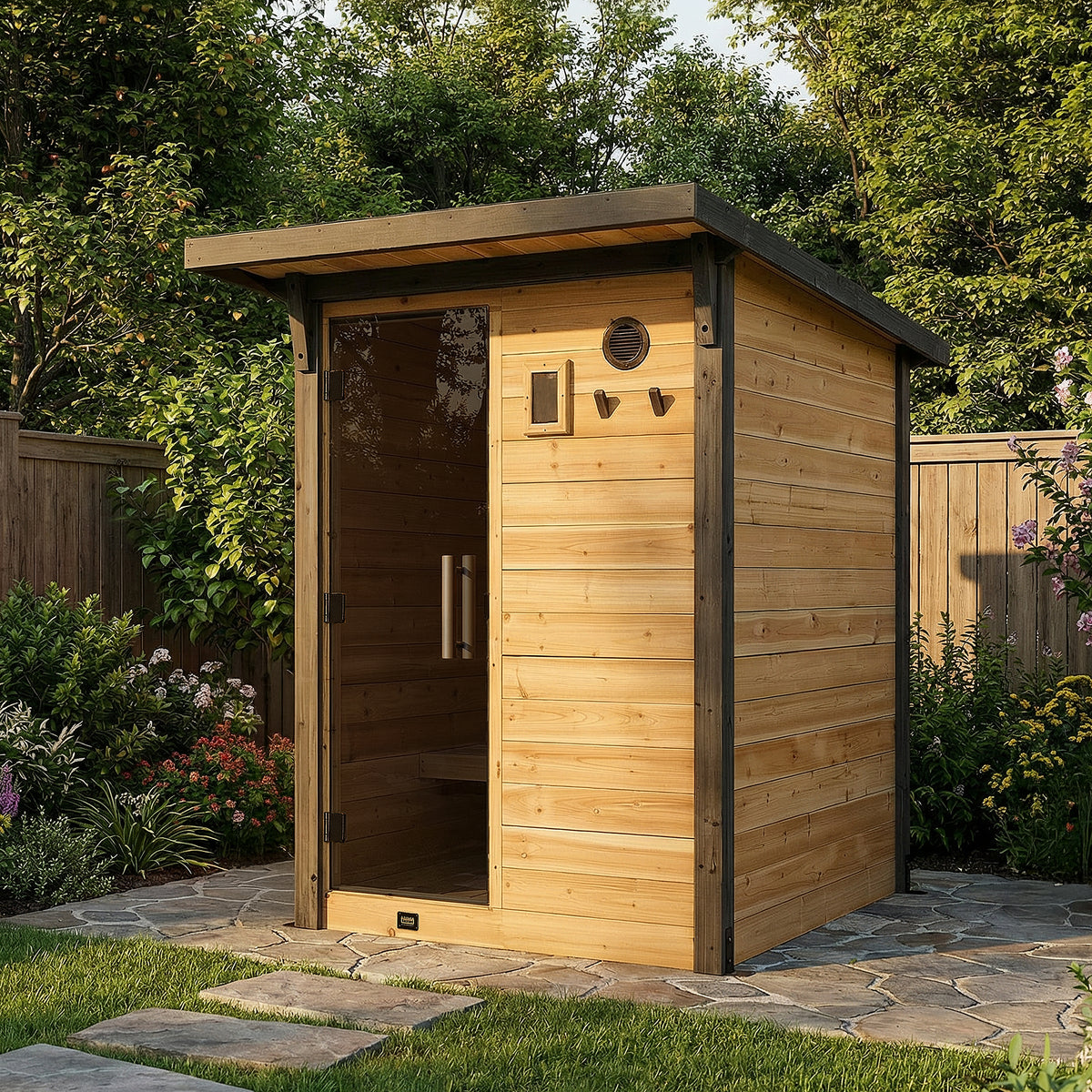
How do the SaunaBox Forge and Backyard Discovery Bennett compare on published specs?
Direct answer
The Bennett is cheaper at $3,999, seats 2 to 4, carries a 5-year comprehensive warranty and is ETL certified. The Forge is $4,990, seats one, and runs on a 20-amp double-pole breaker instead of the Bennett's 50-amp circuit. The Forge occupies 12.4 sq ft of ground. The Bennett occupies 39.3 sq ft. Everything else follows from that difference in scale.
| Specification | Backyard Discovery Bennett | SaunaBox Forge 1-Person | Source / Basis |
|---|---|---|---|
| Sauna type | Traditional outdoor cabin sauna, electric rock stove. | Traditional Finnish outdoor cabin sauna, electric rock stove. Not infrared. | Product pages of both brands. |
| Price | $3,999, free shipping, free driveway delivery. | $4,990 (was $5,500). | Product pages of both brands, August 2026. |
| Capacity | "2-4 people." | 1 person. Single bench with an S-shaped ergonomic backrest. | Product pages of both brands. |
| Heater | "PrairieFire™" 9 kW electric, in-house brand. Heating capacity "462 ACF." Stone capacity "Max of 25 lbs." | Harvia Vega Compact BU 3.5 kW, model #HCBU352401. Finnish commercial-grade. Rated 70.5–175 cu ft. | Product pages of both brands. |
| Electrical requirement | "240V/50 amp hardwired connection." 9,600 Watts. "Professional Electrician Installation Required." | 240V, 14.4A draw. Dedicated double-pole breaker, typically 20A. 14/2 copper conductor. Hardwired, licensed electrician required. | Product pages of both brands. |
| Total peak power draw | 9,600 W published for the heater. | ~3,620 W total. Heater 3,500 W, RGB LED 60 W, fan 60 W. | Product pages of both brands. |
| Maximum temperature | "0°-194°F (-18° to 90°C)" published on the spec table. | More than one figure appears on the SaunaBox product page today. Confirm the current published maximum at saunabox.com before purchase. | backyarddiscovery.com specification table. saunabox.com checked August 2026. |
| Time to temperature | Not published. Marketing states the 9 kW heater "heats up 50% faster than standard 6kW heaters." | 170°F (76.7°C) in approximately 25 minutes from a cold start. | Product pages of both brands. |
| Exterior dimensions | 62.3″ W × 90.8″ D × 81.5″ H including roof overhang. | 43.31″ W × 41.34″ D × 80.71″ H. | Product pages of both brands. |
| Ground footprint | 39.3 sq ft (calculated). | 12.4 sq ft (calculated). Roughly a third of the Bennett's. | Calculated from published exterior dimensions of both brands. |
| Interior dimensions | 50.5″ W × 63.2″ D × 73″ H. "130.5 Cu Ft" published. | 39.37″ W × 37.80″ D × 72.83″ H. Approximately 63 cu ft (calculated). | Product pages of both brands. Volume calculated for the Forge. |
| Wood | Cedar. Wall thickness "30mm." R-value stated as "between 1.4 and 1.8." | Canadian Hemlock interior, described as low-resin and low-odor. Cedar exterior framing under matte black aluminum cladding. Wall thickness not published. | Product pages of both brands. |
| Roof | "29ga powdercoated galvanized steel." | Not published as a separate spec. Exterior is matte black aluminum paneling. | Product pages of both brands. |
| Door | Tempered glass, "8mm." Thickness published, size not. | Full-length black-tinted tempered glass, 64.96″ × 23.62″. Size published, thickness not. | Product pages of both brands. |
| Ventilation | No ventilation specification published. | Active ventilation. Passive intake and exhaust plus a powered 60 W fan. Louvered black vent panel on the exterior. | Product pages of both brands. |
| Lighting | "Dimmable interior LED lights." | RGB LED ambient strip, color-selectable, under the bench and overhead. | Product pages of both brands. |
| Controls | "Wi-Fi control panel" included. | Heater-mounted controls. No app or Wi-Fi control published. | Product pages of both brands. |
| Weight | "Approximately 752 lbs" across 6 boxes. | 471.8 lb assembled. 571.0 lb gross shipping weight with crate. | Product pages of both brands. |
| Shipping and delivery | "Ships in 1-3 days." Free shipping. Free driveway delivery. | LTL freight. One consolidated plywood crate, 85.0″ × 59.4″ × 37.8″. Forklift or 2-person team plus pallet jack. | Product pages of both brands. |
| Assembly | Ready-to-assemble. Pre-cut and pre-drilled. 3D instructions via the BILT® app. Optional assembly service $499. | Ships as a single crate. White Glove Installation available separately at $1,300. | Product pages of both brands. saunabox.com installation listing. |
| Certifications | "ETL Certified." "Full sauna ETL certification." | No safety certification published on the Forge product page as of August 2026. | Product pages of both brands, checked August 2026. |
| Warranty | "5-year comprehensive warranty covering every component," stated as "5-year, no exclusions." | 2-year cabin warranty on frame, cladding, interior wood, door, hardware and cabin components. 1-year on the Harvia heater. | Warranty sections of both brands. |
| Included accessories | Sauna stones, robe hooks, bucket, ladle, thermometer, anchors and all hardware. | Sauna rocks, water bucket and ladle, wooden foot stool. | Product pages of both brands. |
| HSA/FSA | "HSA/FSA Eligible for Qualified Customers." | TrueMed® partner. HSA/FSA for qualified customers. | Product pages of both brands. Neither is an advantage over the other. |
What is the real difference between these two outdoor saunas?
Direct answer
Scale, and what that scale costs you outside the purchase price. The Backyard Discovery Bennett is a 2-4 person cabin that needs 39.3 sq ft of ground and a dedicated 240V 50-amp circuit. The SaunaBox Forge is a single-seat cabin that needs 12.4 sq ft and a 240V 20-amp circuit. Both make the same kind of heat from an electric rock stove. The question is whether you are buying a sauna for a household or a sauna for one person's daily habit.
Be blunt about the capacity gap up front. It is not a small one. The Bennett's own page says "2-4 people." The Forge has a single bench. If you want to sit in a sauna with your partner, this comparison ends here and the Bennett wins it. A one-seat cabin does not become a two-seat cabin because the heater is Finnish.
What is less obvious is that the Bennett's size is not free. It is 90.8 inches deep with the roof overhang. That is over seven and a half feet of yard in one dimension. A lot of city and suburban backyards, side returns, patios, decks and rooftop terraces cannot take that. The Forge is 43.31 by 41.34 inches. It fits on a landing, a narrow deck, a garage bay, a courtyard. That is the whole reason the product exists.
The second cost of scale is electrical. Nine kilowatts needs a 50-amp 240V circuit. Three and a half kilowatts needs a 20-amp one. If your panel has spare capacity and your run is short, that difference is a few hundred dollars of copper. If your panel is full, or the sauna sits a long way from it, that difference can be the deciding factor in whether the project happens at all.
The single most consequential component in any traditional sauna is the stove. It sets the heat, it sets the electrical requirement, it is the part most likely to fail, and it is the part you will one day need a spare element or a control board for.
The Bennett uses a heater Backyard Discovery makes and brands itself, the PrairieFire™ 9 kW. Their page publishes its output, its 462 ACF heating capacity and a 25 lb stone limit. Those are real, useful numbers. What is not published is who manufactures it, or what happens to parts availability in year six.
The Forge uses a Harvia Vega Compact BU 3.5 kW, and SaunaBox publishes the model number: HCBU352401. Harvia is a Finnish sauna heater manufacturer that has been supplying commercial installations for decades. You can look the model up. You can read its own rating, 70.5 to 175 cubic feet. You can price a replacement element without going through SaunaBox.
That is the argument, and it is a narrow one. It is not that the Harvia is a hotter or better stove than the PrairieFire. We have not tested either. It is that one of them is a checkable third-party component with a public model number and a global parts channel, and the other is a proprietary unit you can only source from the brand that sold you the cabin. Buyers who plan to keep a sauna for ten years tend to care about that. Buyers who plan to keep it for four usually do not.
One honest note on power density. The Bennett puts 9 kW into a published 130.5 cubic feet. The Forge puts 3.5 kW into roughly 63 cubic feet, calculated from its published interior dimensions. Per cubic foot, the Bennett actually has more heater behind it. If raw wattage per unit of air is your metric, that row goes to Backyard Discovery.
What kind of heat does each one make, and how does it feel?
Direct answer
Both are traditional saunas, so both heat the air and the rocks, and the hot air carries that heat to your skin. Neither is infrared. On both units you can pour water over the stones for a burst of steam, which is called löyly, but the primary experience in both cabins is high-temperature dry heat. The mechanism is identical. What differs is the volume of air each stove has to move.
This is the part buyers get wrong most often, so it is worth stating plainly. A traditional sauna does not project heat into you the way an infrared cabin does. The stove heats the air and the stones. The air surrounds you, it warms your skin, and your skin carries it inward. That is a real mechanism and it has worked for thousands of years. It is also why traditional saunas run at temperatures an infrared cabin never reaches. The air is doing the delivering, so the air has to be hot.
The SaunaBox page puts it directly in its own FAQ: "This is a traditional dry sauna, not infrared. The Harvia Vega Compact heater warms the air and the sauna rocks... You can pour water over the rocks to create a brief burst of steam (löyly), but the primary experience is dry heat."
Backyard Discovery describes the same behavior for the Bennett. Their page states you can use it as a dry sauna or pour water over the included stones for bursts of steam. Same category, same physics, same ritual.
The practical difference is heat-up behavior. A smaller cabin comes up faster and recovers faster after the door opens. A larger cabin holds more thermal mass once it is hot but takes longer to get there and loses more when someone walks in and out. Neither is better. They suit different session habits. If you sauna alone most evenings and want to be sitting in it twenty-five minutes after you decide to, the small cabin is the one built for that. If you fire it up on a Saturday for the household and leave it running for two hours, the larger cabin is.
How hot does each sauna get?
Direct answer
Backyard Discovery publishes a clear ceiling for the Bennett: "0°-194°F (-18° to 90°C)" on its own specification table. SaunaBox publishes a verified heat-up figure for the Forge of 170°F (76.7°C) in approximately 25 minutes from a cold start. More than one maximum figure currently appears on the SaunaBox Forge page, so we are not printing one here. Check saunabox.com for the current published maximum before you buy.
We would rather concede a row than publish a number we cannot stand behind. Backyard Discovery states a single unambiguous maximum with a matching Celsius conversion, and that is the better disclosure. It is a genuine point in the Bennett's favor and buyers should weigh it as one.
What the Forge page does state consistently, everywhere it appears, is the heat-up: 170°F in about 25 minutes from cold. That is the number that matters most for a one-person cabin used on weeknights, because it is the gap between deciding to sauna and actually sitting in one. Backyard Discovery publishes no heat-up time for the Bennett at all. Their claim is comparative, not absolute, that a 9 kW heater "heats up 50% faster than standard 6kW heaters." That tells you how it compares to a hypothetical alternative. It does not tell you how long you are standing in the yard.
For context on the range: published research on Finnish sauna bathing typically runs protocols in the low 160s Fahrenheit. A 2026 study in Temperature used a measured mean cabin temperature of 73°C, which is 163°F, at 10-20% humidity. Both of these saunas operate comfortably above that. Neither is running short of heat for a normal Finnish session.
What are they built from?
Direct answer
The Bennett is cedar throughout, with a published 30mm wall thickness and a 29-gauge powder-coated galvanized steel roof. The Forge is Canadian Hemlock on the inside, cedar framing on the outside, clad in matte black aluminum panels. Backyard Discovery publishes wall thickness and an R-value. SaunaBox does not publish either.
Cedar is the traditional choice and the one most buyers expect. It is aromatic, it weathers well and it is what most of the barrel and cabin market is built from. Backyard Discovery leans into that, states 30mm solid kiln-dried cedar walls, and publishes an R-value "between 1.4 and 1.8" with no synthetic insulation. Publishing an R-value at all is unusual in this category and it is to their credit.
SaunaBox takes a different approach on the two surfaces. The interior is Canadian Hemlock. That is the wood you actually sit on and breathe. SaunaBox describes it as "light-toned, low-resin, low-odor wood that stays cool to the touch at full temperature." Low resin matters in a stove sauna because resinous species can weep at high bench temperatures. Cool to the touch matters too. At traditional temperatures the bench is what your bare skin sits against for twenty minutes.
The exterior is where they diverge hardest. The Bennett looks like a cedar cabin because it is one. The Forge is clad in matte black aluminum over a cedar frame, with black-tinted glass, matte black hinges and a louvered black vent panel. That is an aesthetic decision as much as a durability one, and it is genuinely polarizing. If you want a sauna that reads as a warm wooden object in the garden, buy the cedar one. If you want a piece of dark architecture on a patio, buy the black one. No spec sheet settles that.
One material gap worth naming: SaunaBox does not publish a wall thickness or an insulation value for the Forge. Backyard Discovery does. If those numbers are how you evaluate a cabin, that comparison is not currently available and you should ask SaunaBox directly.
What electrical work does each one need?
Direct answer
Both require a licensed electrician and a hardwired 240V connection. Neither plugs into a wall outlet. The Bennett needs a dedicated 240V 50-amp circuit at 9,600 watts. The Forge draws 14.4 amps on a dedicated 240V double-pole breaker, typically 20 amps, on 14/2 copper conductor, with a total peak draw around 3,620 watts. That is the single largest practical difference between these two saunas.
This is the row we would look at first if we were buying either one, and it is the one most comparison content skips.
A 50-amp 240V circuit is a serious ask. It needs real panel capacity, heavier gauge wire and, on longer runs to a backyard, a meaningful trench and conduit job. Homes with a full panel often need a subpanel or a service upgrade before the sauna can be energized at all. That is a project quote, not a line item. Backyard Discovery is upfront about it and states "Professional Electrician Installation Required" on the product page.
A 20-amp 240V circuit is closer to what a dryer or a small workshop tool needs. SaunaBox publishes the whole picture: 240V, 14.4A current draw, dedicated double-pole breaker typically 20A, 14/2 copper conductor, hardwired, licensed electrician required, and no cord or plug included. It also publishes an alternative configuration, a Harvia Vega Compact 1.9 kW on 120V, model #HCBU1912241, which it asks buyers to contact SaunaBox about before ordering.
Publishing current draw and wire gauge rather than just "call an electrician" is the useful behavior here, because it lets a homeowner get a real quote before they order. Both brands should be doing it. Only one of them is.
Running cost follows the same line. 9,600 watts versus roughly 3,620 watts is close to a 2.7x difference in draw. We are not going to put a dollar figure on that because electricity rates vary by an enormous margin across the US, and because a bigger cabin is doing more work. But if you plan to run a sauna four or five times a week for years, that gap compounds and it is worth pricing at your own kWh rate.
How does delivery and assembly compare?
Direct answer
The Bennett ships free in 1-3 days with free driveway delivery, arrives as roughly 752 lbs across six boxes of pre-cut and pre-drilled components, and is built with 3D instructions in the BILT® app. Optional assembly service is $499. The Forge ships LTL freight as one consolidated plywood crate at 571 lbs gross and requires a forklift or a two-person team with a pallet jack. White Glove Installation is available separately at $1,300.
Backyard Discovery wins the convenience row and it is not close. Free driveway delivery, a 1-3 day dispatch and a guided app build is a genuinely well-designed customer experience for a product this size. The $499 assembly service is less than half what SaunaBox charges for white glove.
The Forge trades that for a different shape of logistics. One crate is simpler than six boxes in one respect and harder in another. There is less to lose and less to sequence, but a 571 lb crate is not something two people move casually off a truck without equipment. SaunaBox states the handling requirement plainly: forklift, or two people with a pallet jack. Plan the drop point before the freight carrier calls.
We should be direct about something here. You may have seen SaunaBox video content suggesting the Forge assembles in about thirty minutes with a drill. That does not describe this product. It arrives on freight as a crated unit and it needs a hardwired 240V connection by a licensed electrician before it can be used. Budget for the electrical work and the placement, whichever of these two you choose. Neither of them is a weekend afternoon and an extension cord.
What certifications does each sauna carry?
Direct answer
Backyard Discovery publishes "ETL Certified" and "full sauna ETL certification" for the Bennett. SaunaBox does not publish a safety certification on the Forge product page as of August 2026. If a third-party listing mark is a requirement for you, or for your local inspector, the Bennett is the one that documents it today.
This is the clearest gap in the comparison and we are not going to talk around it. ETL is a nationally recognized testing laboratory mark, it is the standard most North American sauna buyers and many local inspectors look for, and Backyard Discovery states it on the page where a buyer can see it. That is exactly what a brand should do.
SaunaBox publishes a great deal of engineering detail for the Forge, including the heater model number, current draw, wire gauge, crate dimensions and shipping volume. It does not currently publish a listing mark for the assembled cabin. Buyers who need one for a permit, an HOA or an insurer should contact SaunaBox and ask for the documentation directly rather than assume it exists. We would rather tell you to ask than let you find out at inspection.
How do the warranties compare?
Direct answer
The Bennett carries a "5-year comprehensive warranty covering every component," described on the product page as "5-year, no exclusions." The Forge carries a 2-year cabin warranty covering the structural frame, exterior cladding, interior wood, door, hardware and all cabin components against manufacturing defects, plus a 1-year warranty on the Harvia Vega Compact heater. Both start from delivery.
Five years beats two, and one covering document beats two with different terms. That row goes to Backyard Discovery and there is no way to read it otherwise.
The detail worth understanding is the split. SaunaBox warrants the cabin for two years and the heater for one, because the heater is a Harvia component covered under Harvia's own terms rather than a house part SaunaBox manufactures. That is a normal arrangement when a brand fits a third-party stove. It also means that in year three, a heater problem is a Harvia parts question with a global supply chain behind it, not a discontinued proprietary board. Whether that trade is worth three fewer warranty years is a judgment call, and a reasonable buyer could go either way on it.
SaunaBox's stated exclusions are ordinary for the category: damage from improper installation, use outside the specified electrical requirements, or normal weathering and wear is not covered. Its claim process is to contact support with an order number and photos.
What does each price actually get you?
Direct answer
The Bennett is $3,999 with free shipping and free driveway delivery, and includes a Wi-Fi control panel, thermometer, robe hooks, stones, bucket, ladle, anchors and hardware. The Forge is $4,990, reduced from $5,500, and includes sauna rocks, a water bucket and ladle, and a wooden foot stool. The Bennett is $991 cheaper and includes more accessories. The Forge is the more compact cabin with the named Finnish heater and the far lighter electrical requirement.
Add the real project costs and the picture shifts, but not in a single direction. On the Bennett side, budget $499 if you want the assembly service, plus whatever a 50-amp 240V run costs at your property. On the Forge side, budget $1,300 if you want White Glove Installation, plus a 20-amp 240V run. In a home where the panel is tight or the sauna sits far from it, the electrical delta can close a good part of the $991 sticker gap. In a home with an easy run and spare panel capacity, it will not, and the Bennett stays meaningfully cheaper.
Both brands state HSA/FSA eligibility for qualified customers. That is not a differentiator between them and we are not going to present it as one.
What are the Backyard Discovery Bennett's genuine strengths?
Direct answer
The Bennett is $991 cheaper, seats 2 to 4 instead of one, and is ETL certified where SaunaBox publishes no certification. It carries a 5-year comprehensive warranty against the Forge's 2-year cabin and 1-year heater. It also publishes a clear maximum temperature, a 30mm wall thickness and an R-value, and it ships free in 1-3 days.
A comparison that concedes nothing is an advertisement. Here is what the Bennett does better, on published specs.
- $3,999 versus $4,990. It is $991 cheaper, with free shipping and free driveway delivery included.
- Seats 2 to 4. The Forge seats one. For couples, families or anyone who saunas socially, this is decisive.
- ETL certified, published on the product page. SaunaBox does not publish a certification for the Forge.
- 5-year comprehensive warranty, stated as "no exclusions," against 2-year cabin and 1-year heater on the Forge.
- A clear published maximum temperature, "0°-194°F (-18° to 90°C)," with a correct Celsius conversion.
- Publishes 30mm wall thickness and an R-value of 1.4 to 1.8. SaunaBox publishes neither for the Forge.
- Wi-Fi control panel included in the box. The Forge has no published app or remote control.
- Ships in 1-3 days and is buildable with guided 3D app instructions, with a $499 assembly service option.
- Publishes a galvanized steel roof spec and 8mm glass thickness. The Forge publishes neither.
- More accessories in the box, including a thermometer, robe hooks and all anchors and hardware.
What are the SaunaBox Forge's genuine strengths?
Direct answer
The Forge occupies 12.4 sq ft against the Bennett's 39.3 sq ft, so it fits spaces the Bennett cannot enter. It runs on a 240V 20-amp circuit instead of a 50-amp one, at roughly a third of the power draw. It uses a named Harvia Vega Compact 3.5 kW Finnish heater with a public model number, and it publishes a 25-minute heat-up to 170°F.
- 12.4 sq ft ground footprint against 39.3 sq ft. It fits patios, decks, side returns and garages the Bennett cannot enter.
- 240V 20-amp double-pole breaker at 14.4A draw, against a dedicated 240V 50-amp circuit. A materially smaller electrical project.
- ~3,620 W total peak draw against 9,600 W. Roughly 2.7x less power on every session.
- Harvia Vega Compact BU 3.5 kW, model #HCBU352401. A named Finnish commercial heater with a public model number and third-party parts availability.
- 170°F in approximately 25 minutes from a cold start, published. Backyard Discovery publishes no heat-up time.
- Active ventilation with a powered 60 W fan plus intake and exhaust. Backyard Discovery publishes no ventilation spec at all.
- Canadian Hemlock interior, low-resin and low-odor, described as staying cool to the touch at full temperature.
- Publishes granular dimensional data most brands do not: interior, bench height and depth, door glass size, crate size and shipping volume.
- Arrives as one consolidated crate rather than six boxes of components to sort and sequence.
- RGB color-selectable ambient lighting under the bench and overhead, and a 120V alternative heater configuration on request.
Who should buy the SaunaBox Forge and who should buy the Backyard Discovery Bennett?
Direct answer
Buy the Backyard Discovery Bennett if you sauna with other people, want to spend less, and have both the yard and the panel capacity for it. Buy the SaunaBox Forge if you sauna alone, your space is tight, or your electrical panel can carry a 20-amp circuit but not a 50-amp one. Space and headcount decide this, not spec sheets.
- You are the only regular user, or almost always sauna alone.
- Your space is tight. 12.4 sq ft fits where a 90-inch-deep cabin does not.
- Your electrical panel is limited, or the run to the sauna is long, and a 20-amp circuit is realistic where a 50-amp one is not.
- You want a named third-party heater with a public model number and long-term parts availability.
- You want to be sitting in it 25 minutes after you decide to, most weeknights.
- You want the matte black architectural look rather than a cedar cabin.
- You want to sauna with a partner, family or friends. It seats 2 to 4.
- You want to spend $991 less and get free shipping and driveway delivery.
- You need a published ETL certification for a permit, an inspector or an insurer.
- You want the longest warranty in this comparison, 5 years comprehensive.
- You have the yard for a 62 by 91 inch structure and a 50-amp circuit is straightforward at your property.
- You want Wi-Fi control included and a guided app-based build with a $499 assembly option.
Frequently asked questions
Neither is better across every category. The Forge wins on footprint, on electrical requirement, on published heat-up time and on having a named Finnish heater with a public model number. The Bennett wins on price, capacity, warranty, ETL certification, published insulation data and delivery speed. The Forge is a one-person cabin for constrained spaces and panels. The Bennett is a household sauna for a yard that can take one.
Electric. The Forge uses a Harvia Vega Compact BU 3.5 kW electric heater, model #HCBU352401, on a hardwired 240V connection. There is no fire to build and no chimney. The Backyard Discovery Bennett is also electric, using a 9 kW PrairieFire heater on a 240V 50-amp circuit. Both are electric traditional saunas with rock stoves.
SaunaBox publishes a verified heat-up figure of 170°F (76.7°C) in approximately 25 minutes from a cold start. More than one maximum temperature figure currently appears on the Forge product page, so confirm the current published maximum directly at saunabox.com before purchase. The Backyard Discovery Bennett publishes a single clear ceiling of "0°-194°F (-18° to 90°C)."
The SaunaBox Forge needs a dedicated 240V double-pole breaker, typically 20 amps, with 14/2 copper conductor. Its current draw is 14.4A and total peak power is around 3,620 watts. The Backyard Discovery Bennett needs a dedicated 240V 50-amp hardwired circuit at 9,600 watts. Both require a licensed electrician. Neither plugs into a standard wall outlet.
No. Both the SaunaBox Forge and the Backyard Discovery Bennett are traditional electric saunas with rock stoves. They heat the air, and the hot air warms your skin. Neither includes infrared panels or red light therapy. If you want infrared, that is a different category of product entirely and these two are not it.
One. The Forge has a single bench with an S-shaped ergonomic backrest, in an interior measuring 39.37 inches wide by 37.80 inches deep by 72.83 inches high. The Backyard Discovery Bennett is published as "2-4 people" with two stacked benches in a 130.5 cubic foot interior. If you need to seat more than one person, the Bennett is the correct choice of these two.
The interior is 100% Canadian Hemlock, described by SaunaBox as light-toned, low-resin and low-odor wood that stays cool to the touch at full temperature. The exterior framing is cedar, clad in matte black aluminum paneling for year-round outdoor use. The Backyard Discovery Bennett is cedar throughout, with a published 30mm wall thickness and a 29-gauge powder-coated galvanized steel roof.
The Forge ships LTL freight as one consolidated plywood crate measuring 85.0 by 59.4 by 37.8 inches, 571 lbs gross, and needs a forklift or a two-person team with a pallet jack. White Glove Installation is $1,300 separately. The Bennett ships free in 1-3 days as roughly 752 lbs across six boxes of pre-cut, pre-drilled parts with 3D app instructions, and offers an optional $499 assembly service. Both still need a licensed electrician for the 240V connection.
The Forge carries a 2-year cabin warranty covering the structural frame, exterior cladding, interior wood, door, hardware and all cabin components against manufacturing defects, plus a 1-year warranty on the Harvia Vega Compact heater. Both run from the date of delivery. The Backyard Discovery Bennett carries a longer 5-year comprehensive warranty described as covering every component with no exclusions.
Yes. Backyard Discovery publishes "ETL Certified" and "full sauna ETL certification" on the Bennett product page. SaunaBox does not publish a safety certification on the Forge product page as of August 2026. If you need a listing mark for a permit, an HOA or an insurer, ask SaunaBox for the documentation directly before you order.
Yes, both. Both are traditional rock-stove saunas and both include sauna stones. Pouring water over the stones produces a brief burst of steam, called löyly in Finnish. Both brands state that the primary experience is still high-temperature dry heat, not a steam room. The steam is an intensity spike within a dry session, not a continuous humid environment.
Both brands state eligibility for qualified customers. SaunaBox is a TrueMed® partner and Backyard Discovery publishes "HSA/FSA Eligible for Qualified Customers." Eligibility comes from having the account plus a Letter of Medical Necessity issued by a licensed provider under IRS Section 213(d). Tax savings vary. This is not a point of difference between these two saunas.
The SaunaBox Forge. Its exterior is 43.31 inches wide by 41.34 inches deep, a ground footprint of 12.4 square feet. The Backyard Discovery Bennett is 62.3 inches wide by 90.8 inches deep including roof overhang, a footprint of 39.3 square feet. The Bennett needs roughly three times the ground area, and its 90.8-inch depth rules out a lot of decks, side returns and narrow patios.
The bottom line
SaunaBox Forge vs Backyard Discovery BennettThe Backyard Discovery Bennett is the better buy on paper for most households. It is $991 cheaper, it seats 2 to 4, it is ETL certified, it carries a 5-year comprehensive warranty and it ships in 1-3 days. If you have the yard and the panel for it, that is a strong package and we are not going to pretend otherwise.
The SaunaBox Forge answers a different question. It is for the person who saunas alone, who does not have 39 square feet of yard to give up, and whose electrical panel can take a 20-amp circuit but not a 50-amp one. It runs a named Finnish Harvia stove with a public model number, it publishes a 25-minute heat-up to 170°F, and it moves a third of the power.
Buy the Bennett if the constraint is budget and headcount. Buy the Forge if the constraint is space and electrical capacity. Two different tools. Pick the one that fits the space you actually have.
See the SaunaBox ForgeSources and references
- SaunaBox Forge 1-Person Traditional Finnish Sauna, product page, specification block and on-page FAQ — saunabox.com. Checked August 2026.
- SaunaBox Forge 1-Person White Glove Installation listing — saunabox.com. Checked August 2026.
- Backyard Discovery Bennett 2-4 Person Outdoor Cabin Sauna, product page and specification table — backyarddiscovery.com. Checked August 2026.
- Laukkanen JA, Laukkanen T, Kunutsor SK. Cardiovascular and Other Health Benefits of Sauna Bathing. Mayo Clinic Proceedings, 2018. Background reading on traditional Finnish sauna bathing.
- Heinonen I et al. Acute Finnish sauna heat exposure induces stronger immune cell than cytokine responses.Temperature (Austin), 2026. DOI 10.1080/23328940.2026.2645467. Open access. Source of the 73°C measured protocol temperature cited above.
HAVE QUESTIONS?
Text a SaunaBox product specialist.
No bots. Real answers in under an hour.
 Text Us Now
Disclaimer: This content is for informational and comparison purposes only and should not be construed as medical advice. All specifications reflect what each brand publishes on its own website as of August 2026. Figures marked "calculated" are our arithmetic on published dimensions, not manufacturer specifications. Verify current specifications, pricing, certification and warranty terms directly with each brand before purchasing. Both saunas require a hardwired 240V connection installed by a licensed electrician. If you have any underlying health conditions, consult a qualified healthcare clinician before beginning sauna therapy.


