


The SaunaBox Solara and the ALEKO Oasis Hemlock Infrared Sauna are both single-person indoor infrared cabins sold in the US right now. The ALEKO Oasis is $2,299 on sale (regular price $2,499). The Solara is $2,599. On price alone these two are close. What is not close is what each box actually emits: the Solara publishes near, mid and far infrared plus a built-in 660nm and 850nm red light panel, while the ALEKO Oasis is far infrared only with no red light therapy mentioned anywhere on its product page. Here is every published number from both brands, with the source named for each one.

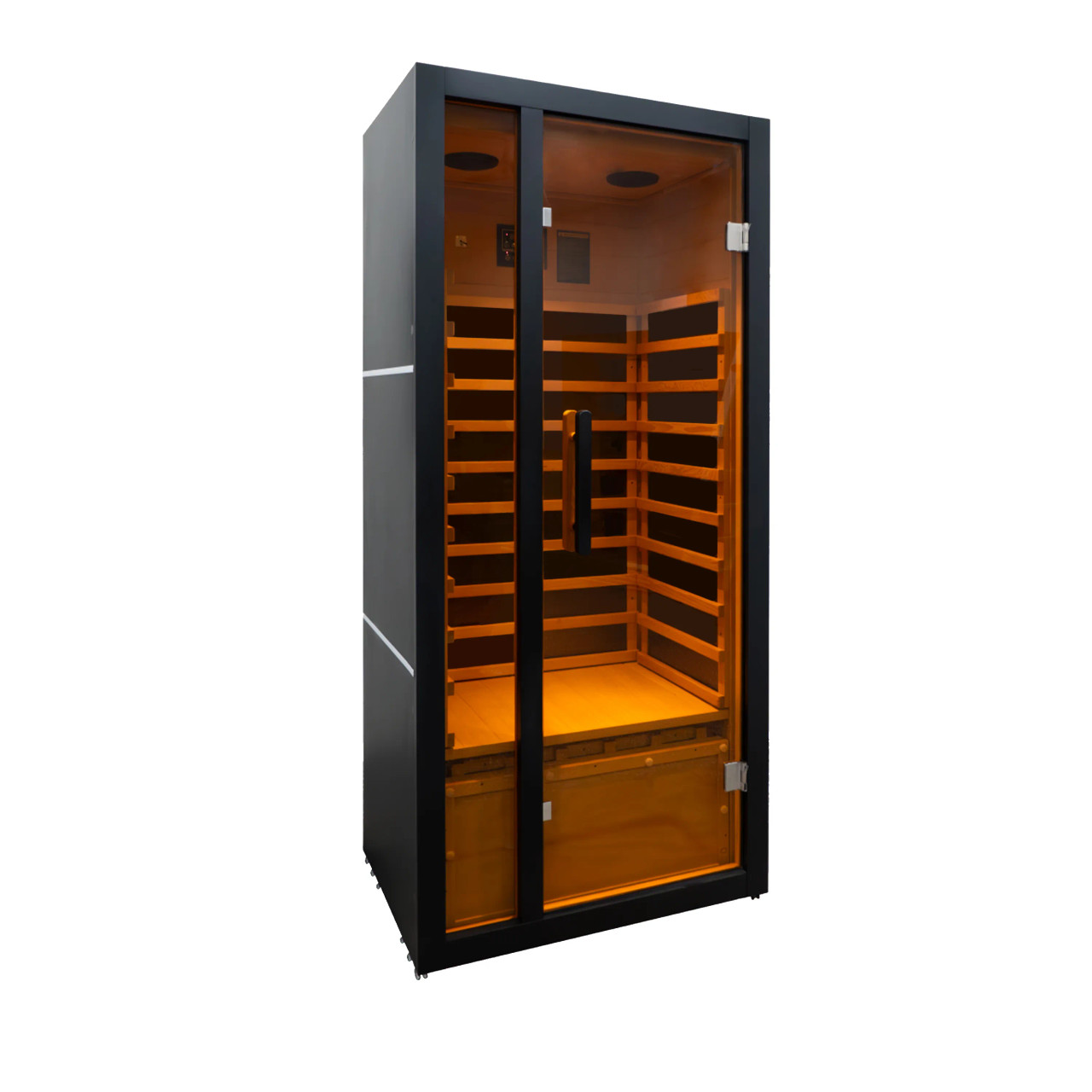
Short answer. The SaunaBox Solara is the better pick if wavelength coverage and red light therapy are why you are buying: it is the only one of these two that publishes near, mid and far infrared plus a built-in 660nm and 850nm red light panel, and the ALEKO Oasis includes neither. The ALEKO Oasis is the better pick if price and zero assembly are what matter most: it is $300 cheaper at today's sale price, ships fully assembled, and publishes interior and bench dimensions the Solara does not. Neither brand publishes a verified EMF testing standard for these two specific models, so treat EMF as an open question on both sides, not a point in either brand's favor.
How this comparison was compiled. Every ALEKO figure here was read off ALEKO's own website, not off a reseller listing or a review site. The primary source is the Oasis Hemlock Infrared Sauna 1-Person product page, cross-checked against ALEKO's infrared sauna collection page. Both checked August 23, 2026. SaunaBox figures come from the live Solara product page and the certifications page, same date. Where a number is calculated rather than published, this page says so and shows the math. No independent side-by-side lab testing was done. Prices move. Check both product pages before you buy.
How do the SaunaBox Solara and ALEKO Oasis compare on published specs?
Direct answer
The ALEKO Oasis costs $2,299 on sale ($2,499 regular) and the SaunaBox Solara costs $2,599. That is a $300 gap at sale price. The Oasis is far infrared only with no red light therapy, ships fully assembled, and publishes both interior and bench dimensions. The Solara adds near and mid infrared plus a 660nm and 850nm red light panel, ships as four panels that clip together in under 30 minutes, and does not publish an interior dimension. ALEKO states ETL certification on the product; SaunaBox states REACH, RoHS, and a Prop 65 heavy-metals-and-phthalates test report for the Solara specifically.
| Specification | ALEKO Oasis 1-Person | SaunaBox Solara | Source / Basis |
|---|---|---|---|
| Price | $2,299 sale (regular $2,499) | $2,599 (reduced from $3,000) | alekoproducts.com/saunas/oasis-hemlock-infrared-sauna-1-person. saunabox.com/products/solara-full-spectrum-infrared-sauna. Both checked Aug 23, 2026. |
| Infrared type | Far infrared only. ALEKO: "Therapeutic infrared heating technology," 6 carbon heaters. No near or mid infrared stated. | Full spectrum. "Near, mid, and far-infrared (NIR, MIR, and FIR)." | alekoproducts.com Oasis product page. saunabox.com Solara specifications block. |
| Red light therapy | Not included. Not mentioned anywhere on the Oasis product page. | "Medical-Grade Red Light: 660nm + 850nm Wave Length," V2 swivel panel, built in. | alekoproducts.com Oasis product page. saunabox.com Solara specifications block. |
| Heaters | "6 carbon heaters." Count published. | "Ultra-Low EMF Infrared Panels." Panel count not published. | alekoproducts.com Oasis product page. saunabox.com Solara specifications block. |
| Wattage | 1,280W total heater power | 1,600W (50/60Hz) | Product pages of both brands. |
| Electrical requirement | 120V. No dedicated circuit stated on the product page. | 110V standard household outlet. No electrician required. 8 ft cord. | alekoproducts.com Oasis product page. saunabox.com Solara product page. |
| Max temperature | 149°F. Range published as 68° to 149°F. | 150°F. Range published as 77° to 150°F. | Product pages of both brands. Essentially identical, 1°F apart. |
| EMF | Not published. No mG figure, no testing standard, no lab named anywhere on the Oasis page. | "Ultra-Low EMF Infrared Panels" is stated as a feature. No mG figure or EMF testing standard (such as IEC 62233) is named on the current product page or certifications page. | alekoproducts.com Oasis product page, checked Aug 23, 2026. saunabox.com and saunabox.com/pages/certifications, checked Aug 23, 2026. |
| Wood / exterior material | "Canadian Hemlock Wood with Melamine Exterior Panels." Exterior surface is a laminate finish, not exposed hemlock. | "100% Canadian Hemlock." Solid wood cabin, no laminate exterior stated. | Product pages of both brands. |
| Door | Tempered glass door. | Reflective glass door, described for privacy. | Product pages of both brands. |
| Exterior dimensions | 33.46″ W × 43.30″ D × 74.8″ H. | 35″ W × 37″ D × 63″ H. Smaller footprint and about a foot shorter. | Product pages of both brands. |
| Interior dimensions | 28.19″ W × 39.37″ D × 70.28″ H. Published. | Not published on saunabox.com as of Aug 2026. | alekoproducts.com Oasis product page. saunabox.com, checked Aug 23, 2026. |
| Bench dimensions | 28.1″ W × 18.9″ D × 0.9″ H. Published. | Not published on saunabox.com as of Aug 2026. | alekoproducts.com Oasis product page. saunabox.com, checked Aug 23, 2026. |
| Assembled weight | Not published anywhere on the Oasis page. | 172 lbs. | alekoproducts.com Oasis product page, checked Aug 23, 2026. saunabox.com Solara specifications block. |
| Assembly method | "Arrives fully assembled." No assembly step at all. | Four pre-assembled panels with pre-installed locking clips. Under 30 minutes, no tools. | Product pages of both brands. |
| Capacity / max user weight | Seating capacity "1 Person." No maximum user weight published. | No maximum user weight published on saunabox.com as of Aug 2026. | Product pages of both brands, checked Aug 23, 2026. |
| Lighting / chromotherapy | Single-color "Orange LED lighting" plus a central reading light. No multi-color chromotherapy stated. | Built-in chromotherapy, 10 colors. | Product pages of both brands. |
| Audio | Not mentioned on the Oasis product page. | Bluetooth speaker / audio system. | Product pages of both brands. |
| Session timer | Digital control panel stated. No specific timer range published. | Time settings 0 to 90 minutes, published. | alekoproducts.com Oasis product page. saunabox.com Solara specifications block. |
| Third-party / chemical certifications | "ETL Certified." An electrical safety mark. No VOC, heavy-metal, phthalate or PFAS testing stated. | Prop 65 heavy-metals-and-phthalates test report (PDF linked), REACH compliant, RoHS compliant, no VOCs detected, PFAS-free, microplastic-free. | alekoproducts.com Oasis product page. saunabox.com/pages/certifications. |
| Warranty | 1-Year Limited Warranty. | 1-Year Limited. | alekoproducts.com Oasis product page. saunabox.com Solara product page. Identical term on both. |
| HSA / FSA | Not mentioned on the Oasis product page. | TrueMed® partner. May be eligible for HSA or FSA funds for qualified buyers. | alekoproducts.com. saunabox.com/pages/certifications. |
What is the real difference between the Solara and the ALEKO Oasis?
Direct answer
The real difference is not price. It is $300 apart, which is close for this category. The real difference is what each brand chose to put in the box. ALEKO built a bigger cabin that ships fully assembled, publishes its interior and bench measurements, and holds an ETL electrical-safety mark. SaunaBox built a smaller cabin around the emitters, publishing near, mid and far infrared plus a dedicated red light panel, and a deeper set of chemical-safety documentation.
This is not a good sauna against a bad sauna. It is a cabinet-and-convenience sauna against a wavelength-and-testing sauna.
ALEKO does not claim full spectrum anywhere on the Oasis page. The copy says "Therapeutic infrared heating technology" and lists six carbon heaters, which is standard far-infrared hardware. That is an honest, common build. Most sub-$2,500 cabins on the market are exactly this: carbon panels, far infrared, no red light.
SaunaBox made the opposite trade. Fewer published dimensions, no stated interior measurement, but a spec block built around wavelength range: near, mid and far infrared plus a 660nm and 850nm red light panel, in one cabin, at $2,599.
So the real question is not "which cabin is nicer." It is whether the extra $300 is buying two more infrared bands and a red light panel, or whether $300 saved is worth going without them.
Is the ALEKO Oasis a full-spectrum infrared sauna?
Direct answer
No. ALEKO's own product page never uses the phrase "full spectrum" for the Oasis. It lists six carbon heaters and calls the system "Therapeutic infrared heating technology," which is standard far-infrared language. There is no mention of near or mid infrared, and no red light wavelength is stated anywhere on the page.
This matters because "infrared sauna" gets used online as if every cabin in the category emits the same thing. They don't. Carbon-panel cabins like the Oasis are common, well-proven, and far infrared only. Full-spectrum cabins need a different heater architecture to reach the near and mid bands, and that shows up in the parts list, not just the marketing copy.
Infrared is one slice of the electromagnetic spectrum. The sauna industry splits it into three bands.
Far infrared (FIR) sits at the long end. It is what carbon heater panels emit naturally, which is why nearly every infrared cabin has it, including the ALEKO Oasis. It is absorbed close to the surface and drives the sweat response people associate with a session.
Mid infrared (MIR) sits between the two. It is associated in the literature with soft tissue and circulation.
Near infrared (NIR) sits at the short end, closest to visible red. It behaves differently from the other two. Near infrared and red light in this general range are what photobiomodulation research studies — the question of what light does to cells, distinct from what heat does to skin.[1][2][3]
"Full spectrum" means the cabin emits all three bands. That is a manufacturing decision, not a marketing one. It needs heater types beyond a standard carbon panel, and it shows up in the bill of materials, not just the copy.
The Solara's specification block reads "Near, mid, and far-infrared (NIR, MIR, and FIR)." The Oasis page lists six carbon heaters and no wavelength breakdown beyond "far infrared" language. Two products in the same broad category, two different heater architectures.
None of this makes far infrared bad. It is the most common, most proven form of infrared heat, and the Oasis is a legitimate example of it. It means only this: if wavelength coverage is why you are buying, the Oasis is not built to deliver near or mid infrared, and its own page does not claim it does.
Does either sauna include red light therapy?
Direct answer
Only the Solara. It has a built-in medical-grade red light panel stated at 660nm and 850nm on a V2 swivel mount, so the light can be aimed at one area. The ALEKO Oasis product page makes no mention of red light therapy, a wavelength figure, or an LED therapy panel of any kind. Its only stated lighting is a single-color orange ambient LED plus a central reading light.
Watch the word "lighting" here, because it gets used loosely across this category. The Oasis has ambient orange lighting for atmosphere. That is not the same category of feature as a wavelength-specific therapy panel. 660nm sits in the visible red band and 850nm sits in the near infrared band. Those two wavelength ranges are the ones most discussed in photobiomodulation research on skin and cellular response, as distinct from a colored bulb that sets a mood.[1][2][3]
If red light therapy is part of why you are shopping, the ALEKO Oasis simply does not have a competing feature to weigh against the Solara's panel. That is not a spin on the numbers. It is what each brand's own product page states, and does not state.
How does EMF compare between the Solara and the ALEKO Oasis?
Direct answer
Neither brand publishes a verifiable EMF figure or testing standard for these two specific models. SaunaBox states "Ultra-Low EMF Infrared Panels" as a feature name on the Solara page, with no milligauss reading or named testing standard on either the product page or the certifications page as of this writing. The ALEKO Oasis page does not mention EMF at all. On this specific row, the honest read is that both brands leave the buyer with a claim and no number.
A magnetic field falls off fast with distance. Move a probe a few inches and the reading changes a lot. So a milligauss figure, or a phrase like "ultra-low EMF," only means something once three things are attached to it: where the probe was, what the appliance was doing, and which measurement method was followed.
That is what a standard like IEC 62233 exists to fix industry-wide. Its title is "Measurement methods for electromagnetic fields of household appliances and similar apparatus with regard to human exposure." A cabin tested to that standard has its sensor placement, operating mode, and measuring distance fixed by the standard rather than chosen by the manufacturer's marketing team.
Neither the current Solara product page nor the SaunaBox certifications page names IEC 62233, a milligauss figure, or any independent testing lab for EMF on the Solara. The feature name "Ultra-Low EMF Infrared Panels" is a manufacturer claim about the panel design, not a published measurement. The ALEKO Oasis page says nothing about EMF in either direction.
Neither absence proves either sauna runs hot or cold on EMF. It means this specific comparison cannot rank the two brands on this row with real numbers, and a page that pretended otherwise would be inventing data. If EMF is why you are shopping, ask both companies directly for a lab report and a named testing standard before you buy either one.
How hot does each sauna get, and how fast does each heat up?
Direct answer
They are essentially tied on maximum temperature. The Oasis publishes a range of 68° to 149°F. The Solara publishes 77° to 150°F. That is a 1°F difference at the top end, which is not a meaningful gap. Neither brand publishes a heat-up time for these models.
Infrared cabins are not judged the way traditional saunas are. Infrared warms the body directly rather than heating the air, so the air temperature ceiling is only one input into how a session feels. A traditional Finnish sauna runs at 190°F and up because it works on a different mechanism entirely. If a very hot, dry room is what you actually want, a stove sauna such as the SaunaBox Forge is the right category, not an infrared cabin from either brand here.
Since neither company states a heat-up time, the only fair move is to compare the power inputs. This calculation is ours. Neither company publishes it.
The math: the Solara is 1,600W in a 35″ × 37″ × 63″ box, which is 47.2 cubic feet, so 33.9 watts per cubic foot. The Oasis is 1,280W in a 33.46″ × 43.30″ × 74.8″ box, which is 62.7 cubic feet, so 20.4 watts per cubic foot. The Solara puts roughly 66% more power into every cubic foot of cabin.
One caveat that matters. Both figures use exterior dimensions, because that is the measurement both brands publish for the Solara. ALEKO also publishes an interior volume of 45.1 cubic feet for the Oasis, which works out to 28.4 watts per cubic foot against its own interior space. SaunaBox does not publish an interior dimension for the Solara, so the same interior-to-interior math cannot be run. Treat the watts-per-cubic-foot figure as a directional signal about heater density, not a measured heat-up time.
Do you need to assemble either sauna, and does either need special electrical work?
Direct answer
The ALEKO Oasis wins this row outright. It arrives fully assembled, so there is no build step at all. The Solara ships as four pre-assembled panels that clip together in under 30 minutes with no tools. Both plug into standard household voltage. Neither product page states that a dedicated circuit is required, and at 1,280W and 1,600W respectively, both draw comfortably inside a standard 15-amp circuit at their published voltages.
This is a genuine point in ALEKO's favor and it would be dishonest to bury it. "Arrives fully assembled" removes a step entirely, where the Solara's under-30-minutes panel assembly, while fast, is still a step. If the goal is to open a box and be in a sauna the same afternoon with zero tool use, the Oasis has the simpler unboxing story on paper.
Where it evens back out is what "fully assembled" implies for delivery and any future move. ALEKO does not publish a shipping or assembled weight for the Oasis anywhere on its product page, so there is no way to know from published data how many people a delivery or a future move will require. SaunaBox publishes 172 lbs for the Solara and describes a four-panel breakdown, which means the same box that assembles in 30 minutes can also be broken back down if the sauna ever needs to move. That is a different kind of convenience than day-one assembly, and neither one cancels the other out.
How much room does each sauna really take up?
Direct answer
The Solara takes 8.99 square feet of floor and stands 63 inches tall. The ALEKO Oasis takes 10.06 square feet and stands 74.8 inches tall, about a foot taller. Neither brand publishes a clearance requirement around the cabinet for these models, so the raw footprint numbers are what you have to plan a room around.
The height difference is the one worth double-checking against your own ceiling. Just under 12 additional inches matters more in a basement, an attic conversion, or a room with sloped ceilings than it does in a standard 8-foot-ceiling bedroom, where both cabins clear with room to spare.
ALEKO does publish something SaunaBox does not for the Solara: a full interior dimension (28.19″ × 39.37″ × 70.28″) and a bench dimension (28.1″ × 18.9″ × 0.9″). That is genuinely useful if you want to know how much usable seated space you are getting inside the box, not just the outside footprint. It is a fair point in ALEKO's favor and it is worth crediting directly rather than only comparing exterior numbers where the Solara looks smaller.
How do the wood and build materials compare?
Direct answer
Both brands build around Canadian Hemlock, but they use it differently. ALEKO describes the Oasis as "Canadian Hemlock Wood with Melamine Exterior Panels," meaning the visible outer surface is a laminate finish over the structure rather than exposed hemlock. SaunaBox describes the Solara as "100% Canadian Hemlock," with no laminate exterior stated. Both use tempered or reflective glass doors.
This is a real distinction worth being precise about. Melamine exterior panels are a common, durable choice in furniture and cabinetry, and ALEKO is upfront about using them rather than hiding it in vague language. It is not a lesser sauna for it. But if solid wood on every visible surface is something you care about, the Solara's stated 100% hemlock construction is the more complete claim on that specific point.
Where the comparison shifts is what has actually been tested. SaunaBox publishes a Prop 65 test report covering heavy metals and phthalates, plus stated REACH and RoHS compliance, VOC-free and PFAS-free claims, and a microplastics-free certification, all specifically referenced for the Solara on the SaunaBox certifications page. The ALEKO Oasis page states "ETL Certified," which is a recognized electrical safety mark similar in spirit to a UL listing, confirming the electrical system meets a safety standard. That is a legitimate and useful certification. It is not the same kind of certification as a chemical-content test, and ALEKO's page does not separately state VOC, heavy-metal, phthalate or PFAS testing for the Oasis.
What does each sauna cost per session, all in?
Direct answer
At four sessions a week over five years, which is 1,040 sessions, the Solara works out to $2.50 a session and the ALEKO Oasis works out to $2.21. At three sessions a week it is $3.33 against $2.95. On pure purchase-price-per-session math, the Oasis is cheaper on any schedule, by roughly 12 to 13%.
Those per-session numbers are ours, from the purchase price divided by an assumed session count. Change the assumption and both move together, so the ratio is the useful part, not the exact dollar figure. On this specific math the Oasis is the better dollar-per-session value.
Neither brand currently publishes an electricity cost per session for these two models, so that line item is left out rather than estimated. One line applies only on the SaunaBox side of the ledger: SaunaBox is a stated TrueMed® partner, and the Solara may be eligible for purchase with pre-tax HSA or FSA funds for qualified buyers with a Letter of Medical Necessity. The Oasis product page makes no mention of HSA or FSA eligibility. If you hold funds in one of those accounts, that is worth checking regardless of which sauna you land on.
What are the ALEKO Oasis's genuine strengths?
Direct answer
The Oasis wins on price, published interior detail, and zero assembly. It is $300 cheaper at today's sale price, it is the only one of the two that publishes an interior and bench dimension, it ships fully assembled with no build step, and it states a specific heater count where the Solara does not.
- $2,299 sale price ($2,499 regular), $300 less than the Solara at today's prices.
- Arrives fully assembled. No panels to connect, no tools, no 30-minute step.
- Publishes full interior dimensions (28.19″ × 39.37″ × 70.28″) and bench dimensions, which the Solara does not.
- Published heater count: 6 carbon heaters, versus "panel count not published" on the Solara.
- ETL Certified, a recognized third-party electrical safety mark.
- Wide brand distribution: sold on ALEKO's own site plus Home Depot, Wayfair, Walmart and eBay listings, useful if you want to compare prices or use a store's return policy.
- Same 1-Year Limited Warranty term as the Solara, so no gap there either way.
- Tempered glass door and orange ambient LED plus a central reading light.
What are the SaunaBox Solara's genuine strengths?
Direct answer
The Solara wins on wavelength coverage, red light therapy, weight transparency, chemical-safety documentation, and cabin footprint. It is full spectrum with a built-in 660nm and 850nm red light panel, where the Oasis is far infrared only with none. It publishes its own assembled weight, a wider range of chemical-safety testing, and a smaller floor footprint.
- Full-spectrum infrared. Near, mid and far, published on the specification block. The Oasis states far infrared only.
- Medical-grade 660nm and 850nm red light built in, on a V2 swivel mount. The Oasis product page states none.
- 1,600W against the Oasis's 1,280W, and roughly 1.7× the watts per cubic foot of exterior volume.
- Publishes assembled weight (172 lbs), which the Oasis page does not publish anywhere.
- Smaller footprint at 8.99 square feet and 63″ tall, versus 10.06 square feet and 74.8″ tall for the Oasis.
- Prop 65 heavy-metals-and-phthalates test report (linked PDF), plus stated REACH, RoHS, VOC-free, PFAS-free and microplastic-free claims.
- Built-in 10-color chromotherapy and a Bluetooth audio system, neither of which the Oasis page states.
- Published session timer, 0 to 90 minutes.
- 100% Canadian Hemlock, with no laminate exterior panel stated, unlike the Oasis's melamine exterior.
- May be eligible for HSA or FSA funds through TrueMed® for qualified buyers. The Oasis page does not mention this.
Who should buy the Solara and who should buy the ALEKO Oasis?
Direct answer
Buy the Solara if wavelength coverage, red light therapy, chemical-safety documentation, or a smaller footprint are what you are optimizing for. Buy the ALEKO Oasis if the deciding factor is the lowest purchase price, zero assembly effort, or knowing the exact interior seating dimensions before you buy.
- You want near, mid and far infrared rather than far infrared alone.
- You want 660nm and 850nm red light in the cabin without buying a second device.
- You want the smaller footprint: under 9 square feet and 63″ tall.
- You want a deeper published record of chemical-safety testing, not just an electrical safety mark.
- You want to know the assembled weight before delivery day.
- You have HSA or FSA funds and want to check whether they can be used.
- You would rather assemble four clip-together panels in 30 minutes than pay $300 more or less for convenience.
- Price is the deciding factor and $300 matters to your budget.
- You want zero assembly, straight out of the box.
- You want the exact interior and bench dimensions published before you buy, not just the exterior footprint.
- You do not need red light therapy or full-spectrum wavelengths.
- You are comfortable with a taller, slightly larger footprint cabin.
- You want the option to buy through Home Depot, Wayfair or Walmart rather than direct.
Frequently asked questions
Neither wins in every category. The Solara wins on infrared spectrum, red light therapy, wattage, footprint, chemical-safety documentation and audio. The ALEKO Oasis wins on price, published interior and bench dimensions, and zero-assembly delivery. If you are buying for wavelength coverage and light therapy, take the Solara. If price and no assembly are what matter most, take the Oasis.
No. The Oasis product page makes no mention of red light therapy or any specific wavelength. Its only stated lighting is a single-color orange ambient LED plus a central reading light. The SaunaBox Solara has a built-in medical-grade red light panel stated at 660nm and 850nm on a V2 swivel mount.
No. ALEKO's own product page never uses the phrase "full spectrum" for this model. It lists six carbon heaters and describes "therapeutic infrared heating technology," which is standard far-infrared language. The SaunaBox Solara publishes near, mid and far infrared (NIR, MIR, FIR) on its specification block.
The ALEKO Oasis is $2,299 on sale, against a regular price of $2,499 on alekoproducts.com as of August 23, 2026. The SaunaBox Solara is $2,599, reduced from $3,000, on saunabox.com the same day. That is a $300 difference at sale pricing. Prices in this category move often, so check both pages before you decide.
No. ALEKO states the Oasis "arrives fully assembled," with no build step. The SaunaBox Solara ships as four pre-assembled panels with pre-installed locking clips that clip together in under 30 minutes with no tools. Neither publishes a shipping or box weight, though SaunaBox does publish the Solara's assembled weight at 172 lbs.
The Solara needs 8.99 square feet of floor and stands 63 inches tall. The ALEKO Oasis needs 10.06 square feet and stands 74.8 inches tall, about a foot taller. Neither brand publishes a clearance requirement around the cabinet for these two models, so those raw footprint numbers are what to plan a room around.
Neither brand publishes a verifiable figure or testing standard for these two specific models, so this cannot be answered from published data. SaunaBox states "Ultra-Low EMF Infrared Panels" as a feature name with no milligauss reading or named standard on the current product or certifications pages. The ALEKO Oasis page does not mention EMF at all.
SaunaBox is a stated TrueMed® partner, so the Solara may be eligible for purchase with pre-tax HSA or FSA funds for qualified buyers who have a Letter of Medical Necessity from a licensed provider. This is not automatic. The ALEKO Oasis product page does not mention HSA or FSA eligibility as of August 2026.
Both carry the same term. The ALEKO Oasis lists a "1-Year Limited Warranty," and the SaunaBox Solara lists "Warranty: 1-Year Limited." This is one of the few rows in this comparison where the two brands are stated identically.
Then neither cabin here is the right category. Infrared warms the body directly instead of heating the air, which is why both of these run at roughly 149° to 150°F rather than the 190°F and up you get from a stove sauna. If you want water on hot stones and a properly hot room, look at a traditional Finnish sauna such as the SaunaBox Forge. Two different mechanisms, two different tools. Pick the one that fits the space and the experience you actually want.
The bottom line
SaunaBox Solara vs ALEKO Oasis Hemlock Infrared SaunaThe ALEKO Oasis is a genuinely solid far-infrared cabin at $2,299. It ships fully assembled, publishes interior and bench dimensions the Solara does not, states a specific heater count, and carries an ETL electrical safety mark. It is also far infrared only, includes no red light therapy, does not publish an assembled weight, and takes up about 12% more floor space and a foot more ceiling height.
The SaunaBox Solara is $2,599, about $300 more at sale pricing. For that difference it adds near and mid infrared, a built-in 660nm and 850nm red light panel, a smaller footprint, a published assembled weight, and a deeper set of chemical-safety documentation covering heavy metals, phthalates, VOCs and PFAS.
If price and zero assembly are what decide this for you, the Oasis earns its lower price. If you are buying for wavelength coverage and light therapy, the Solara is the only one of the two that has it, for $300 more.
Shop the SaunaBox SolaraSources and references
- SaunaBox Solara 1-Person Full Spectrum Infrared Sauna product page, specifications block -- saunabox.com. Checked August 23, 2026.
- SaunaBox safety certifications and HSA/FSA eligibility page -- saunabox.com. Checked August 23, 2026.
- ALEKO Oasis Hemlock Infrared Sauna, 1-Person (SIR1OASBLK-AP) product page -- alekoproducts.com. Source for price, dimensions, weight status, heater count, wattage, electrical requirement, wood/exterior material, assembly method, lighting and warranty. Checked August 23, 2026.
- ALEKO infrared saunas collection page -- alekoproducts.com. Checked August 23, 2026.
- Wunsch A, Matuschka K. A Controlled Trial to Determine the Efficacy of Red and Near-Infrared Light Treatment in Patient Satisfaction, Reduction of Fine Lines, Wrinkles, Skin Roughness, and Intradermal Collagen Density Increase. Photomedicine and Laser Surgery, 2014. PMID 24286286.
- Avci P, Gupta A, Sadasivam M, et al. Low-level laser (light) therapy (LLLT) in skin: stimulating, healing, restoring. Seminars in Cutaneous Medicine and Surgery, 2013. PMID 24049929.
- Barolet D, Roberge CJ, Auger FA, et al. Regulation of skin collagen metabolism in vitro using a pulsed 660 nm LED light source. Journal of Investigative Dermatology, 2009. PMID 19536177.
HAVE QUESTIONS?
Text a SaunaBox product specialist.
No bots. Real answers in under an hour.
Disclaimer: This content is for informational and comparison purposes only and should not be construed as medical advice. All specifications reflect what each brand published on their own website as of August 23, 2026. Calculated figures are labeled as such where they appear. Verify current specifications, pricing and warranty terms directly with each brand before purchasing. If you have any underlying health conditions, consult a qualified healthcare clinician before beginning sauna therapy.


