


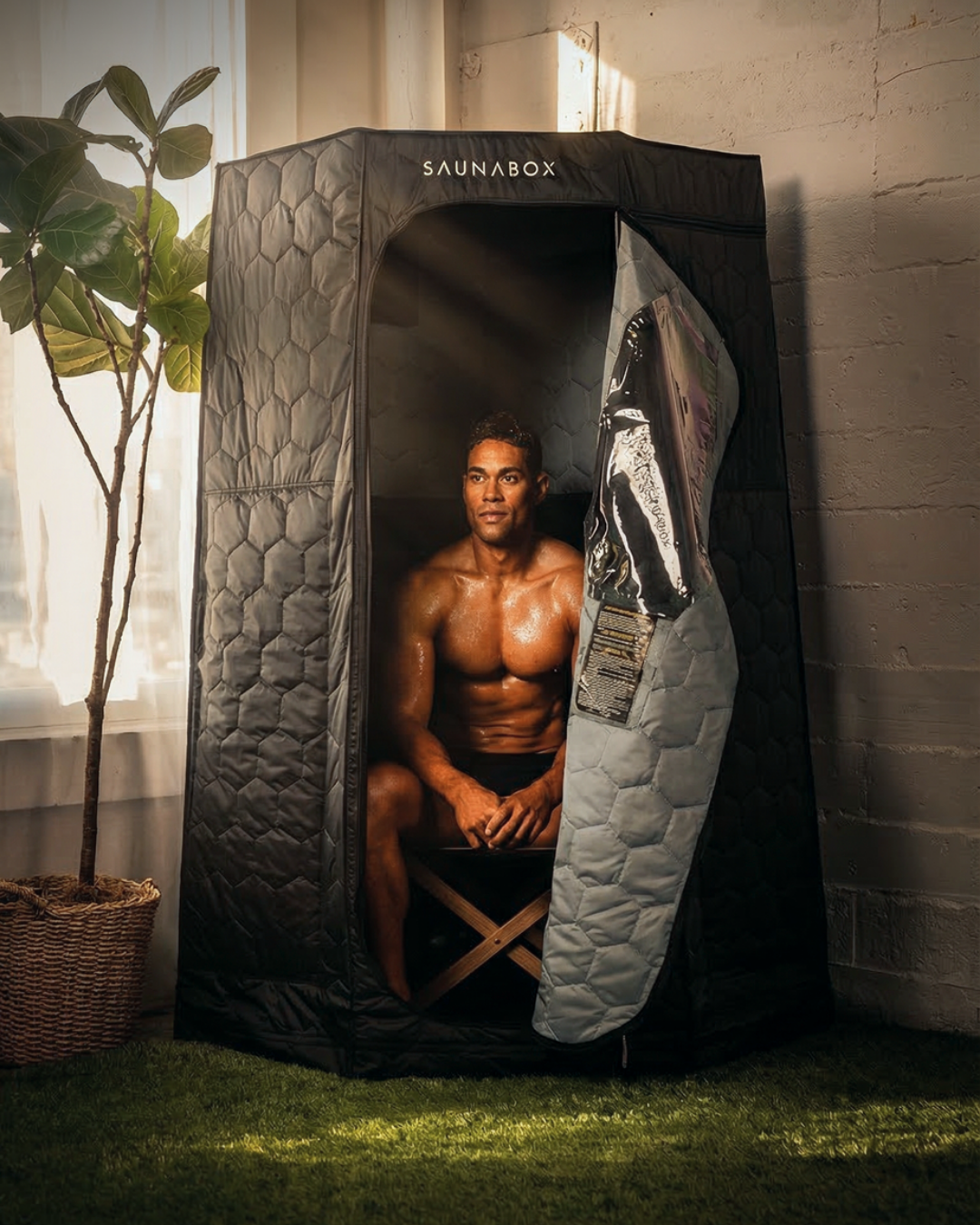
The SaunaBox Pulse PRO and the Bon Charge Infrared Sauna Blanket are both portable infrared products priced at $699, but they deliver heat in completely different ways. The Pulse PRO is a sit-in tent sauna reaching 160°F with far-infrared panels and integrated 660 nm red light therapy. The Bon Charge is a wrap-around blanket reaching 176°F with far-infrared layers. Same price, different experience. Here is how every published spec compares.

How do SaunaBox Pulse PRO and Bon Charge compare on published specs?
| Specification | Bon Charge Sauna Blanket | SaunaBox Pulse PRO | Source / Basis |
|---|---|---|---|
| Product type | Wrap-around infrared blanket. User lies down inside. Head remains outside. | Sit-in tent sauna. User sits upright inside on included chair. Head remains outside. Closer to a traditional sauna experience. | Product pages of both brands, July 2026. |
| Infrared type | Far infrared (FIR) only. Lab-grade infrared heated layers. | Near and far infrared via carbon fiber heating panels. Broader wavelength coverage. | Product pages of both brands. |
| Max temperature | 176°F (80°C). Higher max temperature at blanket surface. | 160°F. Lower max but delivered as ambient heat around the full body. | Product pages of both brands. |
| Red light therapy | No red light therapy included. Infrared heat only. | Yes. Medical-grade 660 nm to 850 nm red light panels integrated. Wavelengths studied in photobiomodulation research. | Product pages of both brands. |
| Body position | Lying down. Limited mobility during session. Some users find this relaxing. | Seated upright on included chair. Head outside tent. Easier to breathe, read, meditate, or use a phone. | Product pages of both brands. |
| Heat delivery | Direct contact. Infrared layers press against skin through blanket material. | Ambient heat. Panels heat the air and surfaces around the body. More even distribution. | Product pages of both brands. |
| Setup time | Unroll and plug in. Seconds to set up. | 15 minutes to set up the tent structure. Folds down for storage. | Product pages of both brands. |
| Portability | Rolls up compactly. 9 kg (20 lbs). Includes carry bag. Highly portable. | Folds down with carry bag included. More portable than a cabin, less portable than a blanket. | Product pages of both brands. |
| Materials certifications | SGS tested for 197 substances including formaldehyde. RoHS conformity. SAA electrical safety. | OEKO-TEX certified. PFAS-free tested. Safety certifications listed on saunabox.com certifications page. | Certifications pages of both brands, July 2026. |
| EMF | Described as "Low EMF design." No specific standard, lab, or mG reading published. | Described as low EMF. Specific mG reading not published on saunabox.com as of July 2026. | Product pages of both brands, July 2026. |
| Timer | 5 to 60 minutes. Adjustable via remote controller. | Timer included. Adjustable session length. | Product pages of both brands. |
| Power | 600W. 100-240V compatible (international use). | Standard outlet. No electrician required. | Product pages of both brands. |
| HSA/FSA eligible | Yes. HSA/FSA eligible per boncharge.com. | Yes. HSA/FSA eligible via TrueMed partnership. | Product pages of both brands. |
| Warranty | 1-year manufacturer warranty. Lifetime technical support. | 1-year limited warranty. Confirm current terms at saunabox.com. | Warranty pages of both brands. |
| Price | $699 USD (currently 25% off at $524.25). | $699 USD (on sale from $900). Same list price. | Product pages of both brands, July 2026. |
What is the real difference between a sauna tent and a sauna blanket?
Direct answer
A sauna blanket heats the body through direct contact. The infrared layers press against the skin through the blanket material while you lie flat. The Pulse PRO tent heats the air and surfaces around your body while you sit upright with your head outside. These are fundamentally different experiences, not just different form factors.
The Bon Charge blanket uses direct-contact infrared. The heated layers press against your body through the blanket material. This creates intense, localized heat at the skin surface. The blanket reaches 176°F at the surface, which is higher than the Pulse PRO's 160°F ambient temperature. However, the heat is delivered differently. Surface temperature in a contact blanket does not equal the ambient temperature experience of sitting in heated air.
The Pulse PRO tent heats the air and panel surfaces around your body. You sit on an included chair with your head outside the tent, breathing ambient room air. The carbon fiber panels radiate infrared energy toward your body from multiple angles. This is closer to how a traditional sauna works and provides more even heat distribution across the body compared to a blanket that only heats the surfaces it touches.
The practical difference: in a blanket, you cannot move. You lie flat, zipped in, with limited mobility. In the Pulse PRO tent, you sit upright and can read, meditate, stretch your arms, or use your phone. For sessions longer than 20 minutes, many users find the seated position more sustainable than lying flat in a heated blanket.
The Pulse PRO also includes 660 nm to 850 nm red light panels, which the Bon Charge blanket does not offer. For buyers who want both infrared heat and red light therapy in a single portable product at the same price point, the Pulse PRO is the only option in this comparison that provides both.
How does max temperature compare, and does it matter?
Direct answer
The Bon Charge blanket reaches 176°F at the surface. The Pulse PRO reaches 160°F ambient. The blanket number is higher, but these are not equivalent measurements. A blanket's surface temperature is measured at the heating element. A tent's ambient temperature is measured in the air around your body. Direct-contact heat at 176°F feels different from ambient air at 160°F.
Both products reach temperatures associated with therapeutic infrared sessions. The more relevant question is how you want the heat delivered: pressed against your skin while lying down, or radiating around your body while sitting up. The temperature difference is less important than the format difference for most buyers.
How do certifications compare between Pulse PRO and Bon Charge?
Direct answer
Both brands publish materials safety testing. The SaunaBox Pulse PRO is OEKO-TEX certified and PFAS-free tested. Bon Charge publishes SGS testing for 197 substances including formaldehyde, RoHS conformity (EU Directive 2011/65/EU), and SAA electrical safety certification.
Both brands take materials safety seriously and publish documentation. The certifications are different standards but serve similar purposes: confirming that the product does not contain harmful substances at levels that would pose a health risk. OEKO-TEX is an independent textile certification. SGS is an independent testing laboratory. Both are credible third-party organizations. This is one of the closer comparison points between these two products.
Does the Pulse PRO include red light therapy?
Direct answer
Yes. The SaunaBox Pulse PRO includes medical-grade red light panels at 660 nm to 850 nm. The Bon Charge Infrared Sauna Blanket does not include red light therapy. If red light therapy is part of your wellness routine or a reason you are considering a portable infrared product, the Pulse PRO is the only option in this comparison that delivers it.
The 660 nm wavelength is in the visible red range and is one of the two wavelengths most studied in photobiomodulation research, alongside 850 nm near-infrared. The Pulse PRO red light panels are positioned inside the tent structure and deliver light to the torso and legs during the session. Irradiance specifications for the Pulse PRO red light panels were not found on saunabox.com as of July 2026. Buyers who prioritize red light therapy as a primary use case should ask SaunaBox for irradiance data in milliwatts per square centimeter.
What are SaunaBox Pulse PRO's genuine strengths in this comparison?
- Seated upright format. Closer to a traditional sauna session. More comfortable for longer sessions.
- Medical-grade red light therapy at 660 nm to 850 nm included. Bon Charge does not offer this.
- Near and far infrared via carbon fiber panels. Broader wavelength coverage than far-infrared-only.
- OEKO-TEX certified and PFAS-free tested. Independent materials safety verification.
- Ambient heat delivery. More even distribution across the body versus direct-contact blanket heating.
- Includes chair. Complete setup out of the box.
Who should buy SaunaBox Pulse PRO and who should buy Bon Charge?
- You want to sit upright during your session rather than lie flat.
- You want red light therapy included in the same product.
- You want near and far infrared, not just far infrared.
- You want OEKO-TEX and PFAS-free certified materials.
- You want ambient heat around your body rather than direct-contact heating.
- You plan sessions longer than 20 minutes and want more comfort.
- You prefer a lying-down, passive heat experience.
- You want the most compact and portable format possible (rolls up, 9 kg).
- You want a higher surface temperature (176°F direct contact).
- You travel frequently and need something that fits in a bag.
- You do not need red light therapy as part of your session.
- You want international voltage compatibility (100-240V).
Frequently asked questions
For buyers who want an upright seated experience, red light therapy, and broader infrared wavelength coverage, the Pulse PRO is the stronger product. For buyers who want maximum portability, a lying-down format, and the highest surface temperature, the Bon Charge blanket may be a better fit. Both are priced at $699 and both are HSA/FSA eligible.
No. The Bon Charge blanket delivers far-infrared heat only. It does not include red light therapy panels. The SaunaBox Pulse PRO includes medical-grade red light at 660 nm to 850 nm. If red light therapy is a priority, the Pulse PRO is the only option in this comparison that provides it.
The Bon Charge blanket reaches 176°F at the surface. The Pulse PRO reaches 160°F ambient. These are different measurements. Surface temperature in a direct-contact blanket is not equivalent to ambient air temperature in a tent. Both reach therapeutic ranges, but the heat is delivered differently.
Yes. Both the SaunaBox Pulse PRO and the Bon Charge Infrared Sauna Blanket are listed as HSA/FSA eligible on their respective product pages. The Pulse PRO uses a TrueMed partnership for HSA/FSA processing. Confirm eligibility with your specific HSA/FSA provider before purchasing.
Bon Charge publishes SGS testing for 197 substances (including formaldehyde, all passed), RoHS Conformity Certificate (EU Directive 2011/65/EU), and SAA Electrical Safety Certification. The SaunaBox Pulse PRO is OEKO-TEX certified and PFAS-free tested. Both brands publish third-party safety documentation, using different certification standards.
The Bon Charge blanket is more portable. It weighs 9 kg (20 lbs), rolls up compactly, and includes a carry bag. The Pulse PRO folds down and includes a carry bag but is larger and heavier than a blanket. If maximum portability is your top priority, the blanket format wins. If you want a more complete sauna experience with red light therapy, the Pulse PRO is worth the extra bulk.
Direct-contact heat (blanket) presses infrared panels against your skin through the material. Ambient heat (tent) radiates infrared energy from panels positioned around your body. Direct contact feels more intense at the surface. Ambient heat distributes more evenly. Traditional saunas use ambient heat. The Pulse PRO replicates this format in a portable product.
Yes. The Bon Charge blanket operates on 100-240V, which means it works with international electrical systems without a voltage converter. The SaunaBox Pulse PRO uses a standard US outlet. Confirm voltage compatibility on saunabox.com if you plan to use the Pulse PRO outside the US.
The bottom line
SaunaBox Pulse PRO vs Bon Charge Sauna BlanketBoth products cost $699, both are HSA/FSA eligible, and both deliver portable infrared heat. The Pulse PRO goes further: seated upright format, integrated red light therapy, near and far infrared, and OEKO-TEX certified materials. The Bon Charge blanket is more portable and reaches a higher surface temperature, but lacks red light therapy and uses far-infrared only.
Same price. The Pulse PRO gives you red light therapy, broader infrared coverage, and a seated sauna experience the blanket cannot match.
Shop the SaunaBox Pulse PROSources and references
- SaunaBox Pulse PRO product page and specifications — saunabox.com. Checked July 2026.
- SaunaBox certifications page — saunabox.com. Checked July 2026.
- Bon Charge Infrared Sauna Blanket product page and specifications — boncharge.com. Checked July 2026.
- OEKO-TEX Standard 100 certification information — oeko-tex.com.
- US Environmental Protection Agency. PFAS Explained. — epa.gov.
- Hamblin MR. Mechanisms and applications of the anti-inflammatory effects of photobiomodulation. AIMS Biophysics, 2017.
- Vatansever F, Hamblin MR. Far infrared radiation (FIR): its biological effects and medical applications. Photonics Lasers Med, 2012.
Disclaimer: This content is for informational and comparison purposes only and should not be construed as medical advice. All specifications reflect what each brand publishes on their website as of July 2026. Verify current specifications, pricing, and warranty terms directly with each brand before purchasing. If you have any underlying health conditions, consult a qualified healthcare clinician before beginning infrared sauna therapy.


